

Irrational Intelligence.
On what organizations and AI have in common, why your workflows are a lie, and what happens when the people building our future don't particularly like humans.

0. THE SYSTEM
We built organizational systems that can process everything, except the thing that actually decides. For years, that was fine. It isn’t anymore. And that’s a fantastic thing.
I. THE BUILDERS
The great tech visionaries weren’t building worlds that excluded people out of malice. They were optimizing for what they could measure. And humans, messy, political, emotionally driven, meaning-seeking, are genuinely hard to measure.
So they got left out of the architecture.
Not removed. Simplified. Reduced to users, clicks, conversion rates, sentiment scores. The parts that couldn’t be quantified got routed around. The parts that could were extracted and fed back as data.
The people building our future don’t really like humans.
It's worth asking why.
(But that’s another article).
The result: planetary-scale systems built on a quiet assumption: that the human parts don’t need to be understood. Only managed.
I have spent seventeen years inside organizations watching leadership teams make the exact same bet. Brilliant people. Genuinely trying. Almost completely unable to see what’s actually happening inside their own companies.
It’s about legibility of hidden value. And AI just made it impossible to ignore.
II. WHAT ORGANIZATIONS ACTUALLY ARE
Here’s something most people haven’t fully sat with yet.
Organizations have always been artificial intelligences.
Not metaphorically. Structurally. Look at what they actually do:
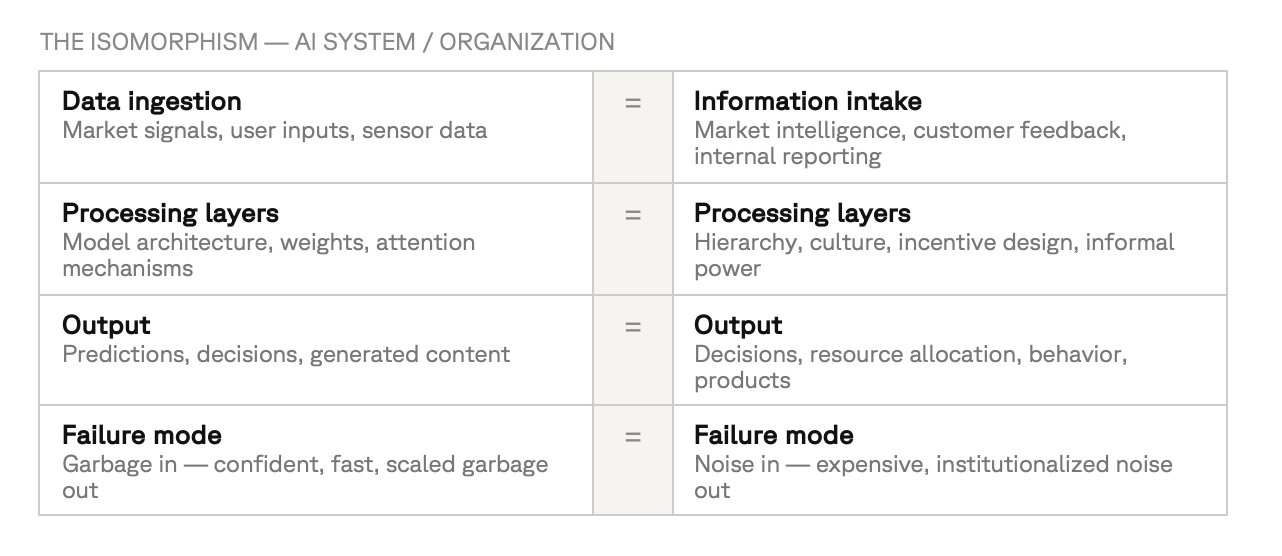
Same architecture. Same dependency on signal quality. Same catastrophic failure when the input is corrupted. However, there is one huge difference.
III. THE SHADOW ORGANIZATION
Back to the lie. Every organization has two versions of itself.
The official one. The org chart, the process documentation, the stated workflows, the values on the wall, the transformation narrative that got approved last quarter and printed on lanyards.
And the real one.
Organizations don’t run on logic alone. They run on contradiction.
Ambiguity. Emotion. Meaning. Power.
The shadow organization. The actual power map. The informal decision logic everyone navigates but no one documents. The real reasons things get approved or killed. The people whose judgment actually moves things, who are often not the people on the org chart. The workarounds that became the workflow. The conversations that happen before the meeting that determine what the meeting decides.
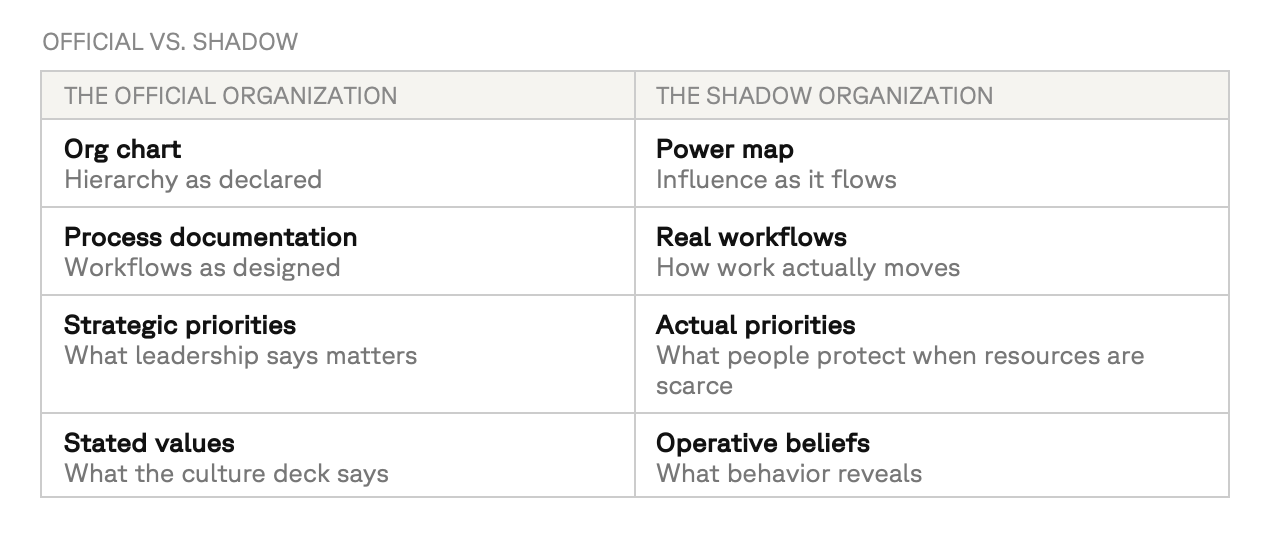
The shadow organization isn’t dysfunction. It’s the accumulated intelligence of how this particular group of humans actually gets things done. It carries the real institutional knowledge. The judgment that took years to build. The relationships that make things move when the process says they shouldn’t.
It is, simultaneously, the organization’s greatest asset and its most dangerous blind spot.
I have walked into enough boardrooms to tell you: the gap between what leadership believes is happening and what is actually happening is almost always shocking. Not because they’re not smart. Because nobody ever showed them the shadow.
IV. THE BLACK BOX PROBLEM
Here’s the uncomfortable parallel nobody’s talking about.
Both AI systems as well as organizations are black boxes.
AI SYSTEMS: The model produces outputs. Nobody, not even the people who built it, can fully explain the generative logic underneath. Which weights fired. Why that decision. Where the intelligence lives. We’re spending billions trying to solve this. We call it interpretability. Also black boxes
ORGANIZATIONS (Also black boxes): Most leaders know their outputs: revenue, market share, product. They cannot explain the generative logic underneath. Where value is created. Which conversations, relationships, specific human judgments produce the thing that makes this organization worth anything at all. We’ve never even named this problem.
They can describe the official version. The org chart, the process, the workflow documentation. They cannot describe the shadow. The real value architecture. The actual source.
Which means when optimization pressure arrives — and it has arrived — they do what people always do when they can’t see clearly: cut what’s visible and preserve what’s loud. Automate the workflows they can document. Eliminate the judgment they never mapped.
And hollow out the organization that made them special in the first place.
I have seen this happen. It doesn’t look like failure. It looks like efficiency. The ROI projections are excellent.
V. WHAT’S ACTUALLY IN THERE
Before we talk about what to do with it, let’s be precise about what’s being lost.
Because this isn’t abstract. The irrational intelligence sitting dormant in most organizations is specific and extraordinary. It’s been there all along, generating value that nobody traced back to its source.
Decades of accumulated judgment.
About what works in this specific market, with these specific customers, under these specific conditions. It never made it into any strategy document because the person who carried it didn’t have the right title. It lives in the head of the sales director who’s been here twelve years, the account manager who knows every buyer personally, the engineer who tried this exact approach in 2014 and knows precisely why it failed.
Relationships that move things in hours.
That the official process takes months to achieve. Invisible to leadership. Irreplaceable in practice. The phone call that unlocks a decision. The trust built over years that makes a difficult conversation possible. None of it on any org chart. All of it load-bearing.
Pattern recognition so refined it looks like instinct.
Because it is instinct. Built from thousands of iterations that nobody logged. The person who reads a room and knows the deal is dead before anyone has said so. The one who senses the market shift six months early. Called irrational because it can’t be explained. Correct more often than the model.
Creative tension between people who see things differently.
That produces something neither would reach alone. But only if you don’t flatten it into consensus too early. The friction that feels like a problem in every meeting is often the organization’s most generative force:unrecognized, unprotected, and the first thing to go when efficiency becomes the priority.
The shadow organization isn’t just the real organization.
It’s the organization’s accumulated genius.
Unrecognized. Unmapped. Running quietly underneath everything that gets measured and reported and presented at the quarterly review.
And none of it can be leveraged until it’s seen. None of it can survive the next optimization if nobody knows it’s the thing worth protecting. None of it can meet the machine as an equal while it remains illegible- even to the people who carry it.
Making it readable doesn’t diminish it.
It’s the precondition for it finally being used at the level it deserves.
V. THE COLLISION… AND WHY IT’S BRILLIANT
Here’s where I want to push back on the doom narrative. Because I actually find this moment extraordinary. We are not at the end of human organizations. We are at the moment where two kinds of intelligence are finally capable of meeting productively.
TECHNICAL INTELLIGENCE
Machine-legible systems
Data, infrastructure, execution logic. Processes that can be automated, scaled, optimized. Speed and precision at a level humans can’t match.
HUMAN INTELLIGENCE
Irrational intelligence
Meaning, power, judgment, contradiction, emotion. The specific knowledge that lives in this organization, these people, this history. Irreducibly particular. Irreducibly human.
The organizations that define the next decade aren’t the ones that suppress one in favor of the other. They’re the ones that make both fully legible and let them collide productively. As two fully expressed polarities generating something neither could produce alone.
But that requires the excavation work first. Going into this specific organization. Distinguishing the shadow from the official. Surfacing the real generative logic, the irrational intelligence that actually moves things. Making it legible enough to be an input rather than an obstacle.
That work cannot be templated. I know, because I’ve tried to find shortcuts. There are none, except two ingredients that help the process: Radical honesty and experience. Every organization built a different shadow. Different power topographies, different informal logics, different pockets of judgment that no model was trained on and no consultant has mapped.
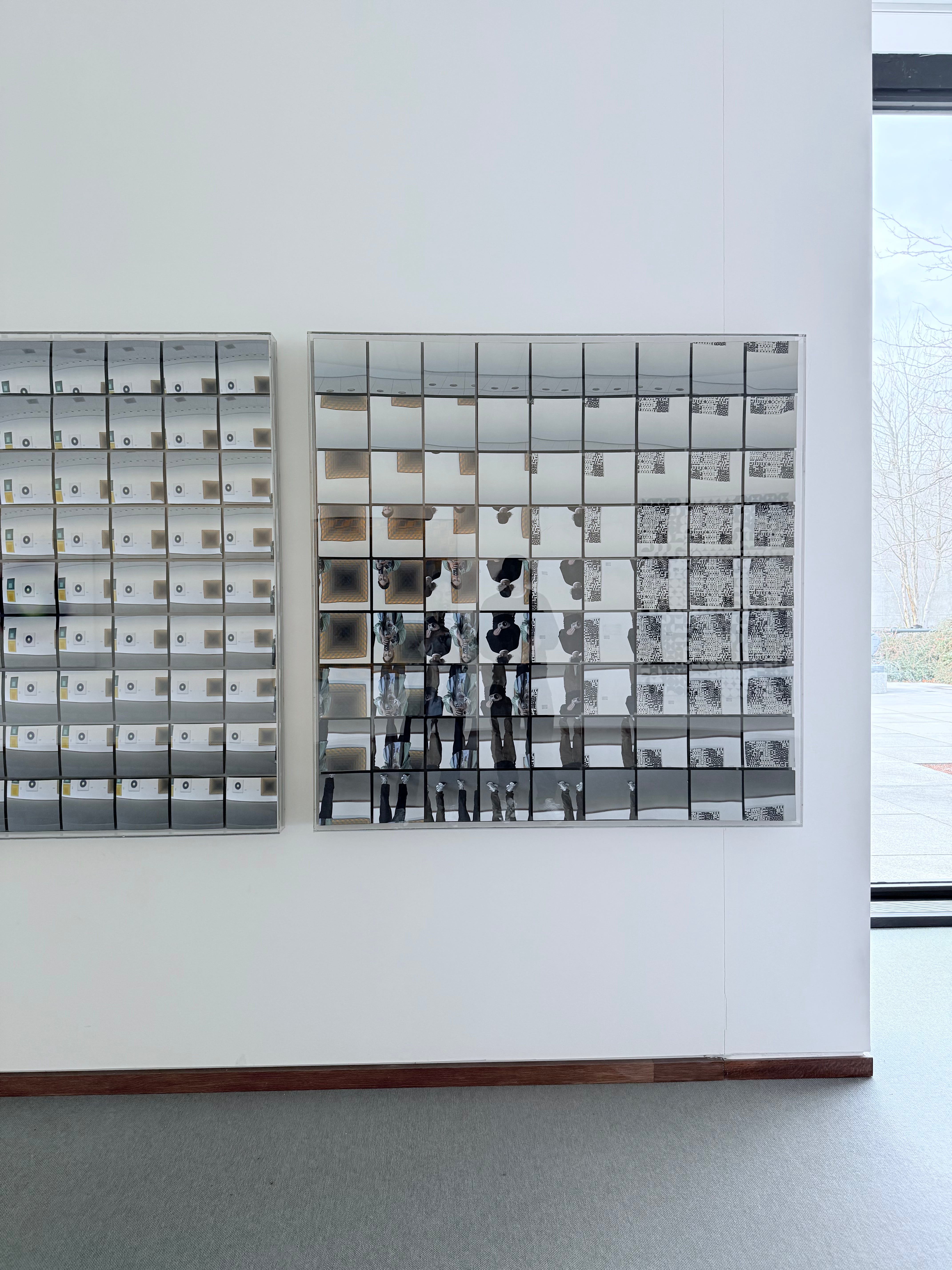
The irrational intelligence of this specific organization is the only asset that can’t be replicated. Everything else scales. That doesn’t.
The machine is coming. It will optimize everything it can see. The question is whether you know what it can’t.
Most leaders don’t. Not because they’re not paying attention. Because the irrational intelligence that actually generates value in their organization - the shadow, the real workflows, the judgment and contradiction and meaning that never made it into any process document - was never made legible. Not to the machine. Not even to them.
You’ve been running a system you don’t fully understand.
For years, that was enough. It isn’t anymore.
That’s the work.
I do it for a living. You know where to find me.
This is one of the best analyses of the current state of many companies. I’m impressed.